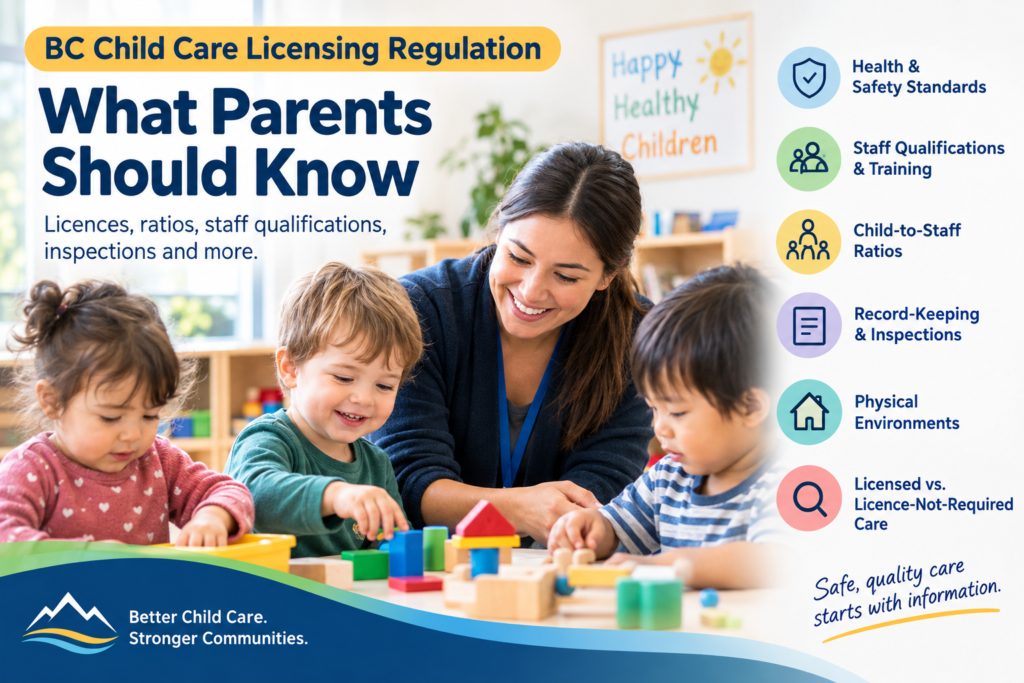
The BC Child Care Licensing Regulation (B.C. Reg. 332/2007) is the provincial rulebook for licensed child care. It sets requirements for health and safety, staff qualifications, child-to-staff ratios, record-keeping, and physical environments, and regional health authorities enforce it through inspections. Licensed providers must meet these standards. If not, the rules may not apply.
If you are choosing licensed child care in Victoria, understanding this regulation helps you ask better questions and spot a safe, well-run program.
What is the Child Care Licensing Regulation?
The regulation falls under BC’s Community Care and Assisted Living Act. It replaced an older regulation in 2007. Its purpose is simple: set minimum standards so children are safe, supervised by qualified adults, and cared for in suitable spaces. The Ministry of Education and Child Care now oversees child care, but health authorities such as Fraser Health, Interior Health, Island Health, Northern Health, and Vancouver Coastal Health carry out licensing inspections locally.
Types of licensed child care in BC
The regulation defines several care programs. The main ones parents encounter are:
- Group Child Care (Under 36 Months): centre-based care for infants and toddlers.
- Group Child Care (30 Months to School Age): centre-based care for preschool-aged children.
- Group Child Care (School Age): before- and after-school care.
- Preschool: typically shorter, part-day programs.
- Multi-Age Child Care: a mixed-age group in a licensed setting.
- In-Home Multi-Age Child Care: a licensed program run from the licensee’s home.
- Family Child Care: small-group care in a provider’s home.
- Occasional Child Care: short-term or drop-in care, such as at a gym or resort.
At Freedom ChildCare Centre, families can explore our child care services, including the toddler program and the preschool program.
Staff-to-child ratios in BC
Ratios are one of the most important protections in the regulation. Government and health authority summaries list these examples:
| Care type | Typical ratio |
|---|---|
| Group care, under 36 months | 1 staff: 4 children |
| Group care, 30 months to school age | 1 staff: 8 children |
| Preschool | 1 staff: 10 children |
| Multi-age child care | 1 ECE: 8 children |
| In-home multi-age | 1 ECE (the licensee) : 8 children |
| Family child care | 1 responsible adult (the licensee) : 7 children |
Ratios work alongside maximum group sizes and limits on how many younger children can be in one group. Always confirm the exact ratio for your child’s age with the provider or your health authority, since conditions on a specific licence can vary.
Staff qualifications
Requirements depend on the program type. In multi-age care, the educator must hold an Early Childhood Educator certificate, which involves roughly 900 hours of training. Infant and toddler programs also require specialized credentials. Beyond training, staff must pass criminal record checks, and the regulation addresses staff health and first aid. gov
When touring a centre, ask:
- What ECE or Infant Toddler Educator credentials do staff hold?
- Is first aid training current?
- What is your staff turnover?
What does the regulation require beyond ratios?
- Safe premises: adequate indoor and outdoor space, safe equipment, and hazard controls.
- Health practices: hygiene, illness policies, medication handling, and emergency plans.
- Records: attendance, child information, and incident documentation.
- Posted licence: licensees must display their licence.
- Serious incident reporting: serious incidents must be reported to the licensing authority and to parents.
- Children needing extra support: the regulation recognizes children who need additional support and expects providers to plan for them.
Licensed vs. licence-not-required (LNR) care
This distinction matters. BC recognizes four categories: licensed, registered licence-not-required, licence-not-required, and care in the child’s own home. LNR providers may care for a small number of children without a licence. The limit is one adult per two children, or a sibling group, per premises. Unregistered LNR providers have no required qualifications. Registered LNR providers have completed additional steps, such as screening and basic training.
LNR care is not necessarily unsafe, and many families use it happily. But the Child Care Licensing Regulation’s inspections, ratios, and qualification rules do not apply to it, so parents need to do their own vetting: references, a visit, and clear conversations about emergencies and supervision.
How to check a provider before you enrol
- Ask to see the licence and confirm the program type and age range.
- Search your health authority’s website for facility inspection reports.
- Read the reports: look for patterns, not a single minor item, and how quickly issues were fixed.
- Visit during operating hours and count the adults and children.
- Ask about policies: discipline, sleep supervision, allergies, and incident communication.
- Contact licensing directly if something looks wrong.
How to raise a concern
If you believe a licensed facility is breaking the rules, contact the licensing office at your regional health authority. Licensing officers can investigate, inspect, and require corrections. If a child is in immediate danger, call 911. Concerns about unlicensed operators offering more care than the law allows should also be reported to your health authority.
Frequently asked questions
Is child care licensing mandatory in BC?
Generally, yes, if a provider cares for more than the limits allowed under licence-not-required rules. Smaller arrangements can be legally exempt.
Who enforces the Child Care Licensing Regulation?
Regional health authorities, through licensing officers who inspect and monitor facilities.
Can I see a daycare’s inspection history?
Yes. Health authorities publish inspection information, and providers must be able to show their licence.