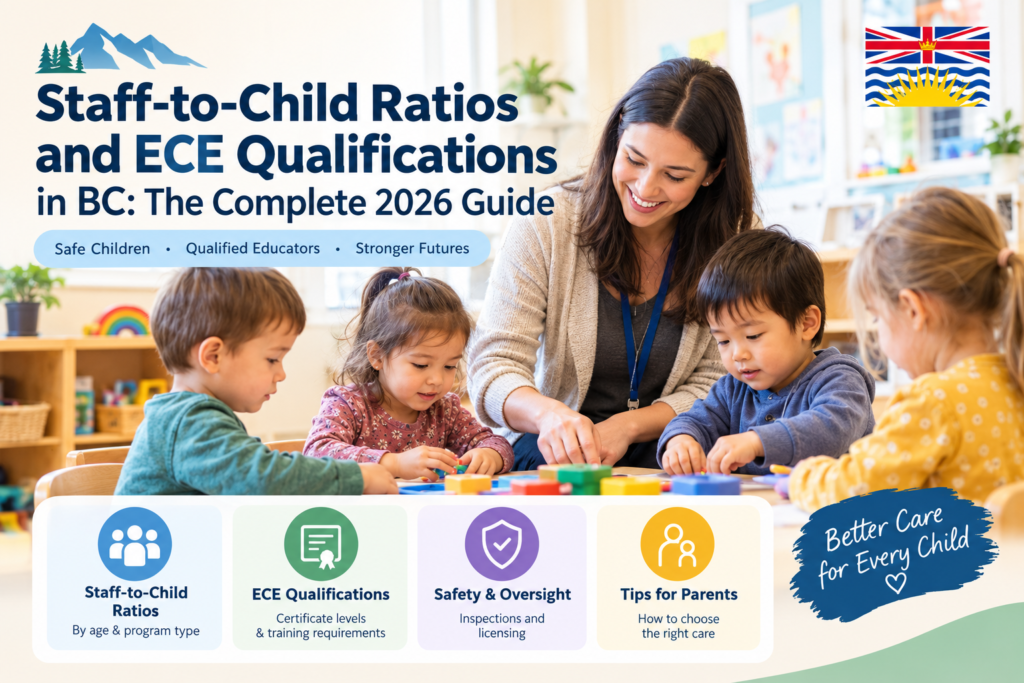
In British Columbia, licensed group child care for ages 30 months to school age requires 1 Early Childhood Educator (ECE) for up to 8 children, with a maximum group size of 25. For children under 3, groups are capped at 12, and an Infant Toddler Educator (ITE) must lead the team.
Choosing child care is a big decision. BC regulates ratios and staff training under the Community Care and Assisted Living Act and the Child Care Licensing Regulation, and regional health authorities inspect licensed facilities. This guide explains what the rules say and what they mean for parents, educators, and providers.
What Is a Staff-to-Child Ratio?
A staff-to-child ratio is the maximum number of children one qualified educator can supervise at once. Ratios work together with group size limits, which cap how many children can share a space. Lower ratios mean more attention, safer supervision, and better emergency response.
Staff-to-Child Ratios in BC by Program Type
| Program type | Ages | Max group size | Ratio/staffing |
| Group care (under 3) | Birth–36 months | 12 | 1–4 kids: 1 ITE; 5–8: 1 ITE + 1 ECE; 9–12: 1 ITE + 1 ECE + 1 ECE Assistant |
| Group care (30 months–school age) | 30 months–Kindergarten | 25 | 1–8: 1 ECE; 9–16: 1 ECE + 1 Assistant; 17–25: 1 ECE + 2 Assistants |
| Preschool | 2.5 years–school age | 20 | 1–10: 1 ECE; 11–20: 1 ECE + 1 Assistant |
| Multi-age care | Birth–12 years | 8 | 1 ECE per 8 children |
| In-home multi-age care | Birth–12 years | 8 | 1 ECE (also the licensee) per 8 |
| Family child care | Birth–12 years | 7 | 1 responsible adult (the licensee) per 7 |
| School-age care | Kindergarten and up | 24 (K–Gr 1) or 30 (Gr 2+) | 1 adult per 12 (K–Gr 1); 1 per 15 (Gr 2+) |
| Occasional care | 18 months and up | 16 or 20 | 1 adult per 4 (with under-36-month children); 1 per 8 otherwise |
Infant and Toddler Care (Under 3)
Younger children need closer supervision, so BC uses tiered staffing. A group of 12 needs three staff: an Infant Toddler Educator, an ECE, and an ECE Assistant. Only one ITE is required, but the number of qualified adults rises as the group grows.
Preschool and Group Care (Ages 3 to 5)
For children from 30 months to school age, one ECE can supervise up to 8 children. Add an ECE Assistant at 9 children and a second assistant at 17. Preschools run smaller groups of up to 20.
School-Age Care
Before- and after-school programs use “responsible adults” rather than ECEs. Ratios are 1:12 for Kindergarten and Grade 1, and 1:15 for Grade 2 and older.
ECE Qualifications in BC: Certificate Levels Explained
The BC Early Childhood Educator (ECE) Registry issues certification. There are several levels.
ECE Assistant (ECEA): Requires completion of one early childhood education course. Assistants work alongside ECEs and ITEs with children from birth to age 5.
ECE One Year Certificate: Held by recent graduates of a recognized ECE program who haven’t yet logged 500 supervised work hours. It lets you work as a fully certified ECE while you gain that experience, and you can renew it only once.
ECE Five Year Certificate: Requires a recognized ECE program plus 500 hours of work experience supervised by a certified Canadian ECE (approximately 900 hours of training overall). ECEs can work alone as the primary educator with children aged 3 to 5, and alongside an ITE in programs for children under 36 months.
Infant and Toddler Educator (ITE): Requires the ECE Five Year Certificate plus an approved infant and toddler program (approximately 1,300 hours of training in total). ITEs can lead programs for children from birth to age 5.
Special Needs Educator (SNE): Another specialization added to the ECE Five Year Certificate for educators supporting children with additional needs.
Renewal and Professional Development
Certificates must be renewed every five years. ECE Five Year, ITE, and SNE holders must complete at least 40 hours of relevant professional development to renew.
Qualifications for School-Age and Family Care
Staff in school-age care and family child care don’t need an ECE certificate. They must be 19 or older, able to provide mature guidance, hold a valid first aid certificate and a clear criminal record check, and complete 20 hours of child care-related training with relevant experience.
Licensed vs. Licence-Not-Required Care
Licensed facilities are inspected by health authorities and must meet the standards above. Licence-not-required providers may legally care for only two children (or one sibling group) not related to them. They have no mandatory qualifications and aren’t monitored or inspected. Parents are responsible for overseeing care in these arrangements.
Why These Standards Matter
Research on child care consistently links lower ratios and smaller groups to more responsive care and better developmental outcomes. Strong certification requirements also protect children by ensuring educators understand child development, health, safety, and inclusive practice. For providers, compliance protects your licence. For parents, it’s a reliable measure of quality.
Tips for Parents
- Ask which certificates the staff hold, and confirm the program meets the ECE/ITE requirements for your child’s age.
- Check the facility’s public inspection report.
- Observe the room at drop-off. Are the adults actively engaged, and does the group look within the legal size?
- Contact your local Child Care Resource & Referral (CCRR) centre for help finding care and funding.
Frequently Asked Questions
What is the staff-to-child ratio for toddlers in BC?
For children under 36 months, one ITE can care for up to 4 children. At 5 to 8 children, an ECE must be added, and at 9 to 12, an ECE Assistant joins the team.
What is the maximum group size for licensed child care in BC?
It’s 12 for under-3 care, 25 for ages 30 months to school age, 20 for preschool and 8 for multi-age care.
How long does it take to become an ECE in BC?
Graduates of a recognized ECE program can apply for a One Year Certificate, then complete 500 supervised work hours to qualify for the Five Year Certificate.
Do school-age child care staff need an ECE certificate?
No. They must be 19 or older with 20 hours of child care training, first aid, and a clear criminal record check.
Who enforces these rules?
Regional health authorities license, inspect, and monitor facilities under the Child Care Licensing Regulation.
Final Thoughts
BC’s ratios and certification system exist to keep children safe and supported at every age. Whether you’re a parent comparing centres or an aspiring educator mapping your career, knowing these rules helps you make confident decisions. Always confirm current details with the Ministry of Education and Child Care and the ECE Registry, since regulations can change.